Infant Massage Specialist Certification Course
Designed for doulas, nurses, midwives, newborn care specialists, childcare providers, lactation professionals, childbirth educators, early childhood professionals, and other family-support providers, this $279 Infant Massage Specialist Certification Course includes 90+ hours of practical, evidence-informed training—delivered in a flexible, fully online format for busy professionals.
What you’ll gain:
Evidence-informed curriculum — learn the “why” behind touch in plain language, with a focus on baby cues, regulation, bonding, and safety—so you can teach families with confidence and credibility.
Lifetime access — no expirations, renewals, or hidden fees. Once enrolled, you keep access to all course updates.
Flexible, self-paced learning — 100% online and designed for real life, with support available when you need it.
Accessible and inclusive — open to all education levels and ages, with no prerequisites required.
Built for real-world practice — ready-to-use session outlines, cue guides, consent-centered scripts, and parent handouts you can use immediately in private sessions or group classes.
Upon completion, you’ll be recognized as a trusted professional equipped to provide safe, respectful, baby-led infant massage education. You’ll also earn the Certified Infant Massage Specialist (CIMS) credential—demonstrating your skills to families, employers, and care teams.
-
-
Lesson 1.0: Course Overview — Welcome to Infant Massage Specialist Training
This course overview introduces DNT Network’s Infant Massage Specialist Certification Course and gives you a clear picture of what to expect. You’ll learn how the course is structured, what topics you’ll cover, and how this training helps prepare you to teach safe, respectful, baby-led infant massage with confidence.
This course overview introduces DNT Network’s Infant Massage Specialist Certification Course and gives you a clear picture of what to expect. You’ll learn how the course is structured, what topics you’ll cover, and how this training helps prepare you to teach safe, respectful, baby-led infant massage with confidence.
-
Lesson 1.1: What Infant Massage Is (and Isn’t)
Infant massage is a gentle, cue-based way to support comfort and connection through touch. It is not a medical treatment, and it won’t “fix” every issue like colic or sleep overnight. In this lesson, you’ll learn what outcomes are realistic and which common myths can set parents up for disappointment. You’ll also learn what an Infant Massage Specialist can do—and when to refer out.
Infant massage is a gentle, cue-based way to support comfort and connection through touch. It is not a medical treatment, and it won’t “fix” every issue like colic or sleep overnight. In this lesson, you’ll learn what outcomes are realistic and which common myths can set parents up for disappointment. You’ll also learn what an Infant Massage Specialist can do—and when to refer out.
-
Lesson 1.2: Infant Massage Through History
Infant massage has been used in many cultures for generations as a way to calm babies and support daily care. While styles vary, the common goal is comfort, connection, and gentle body support. In this lesson, you’ll learn how infant massage developed over time and why it remains popular today. You’ll also learn what modern infant massage classes typically include.
Infant massage has been used in many cultures for generations as a way to calm babies and support daily care. While styles vary, the common goal is comfort, connection, and gentle body support. In this lesson, you’ll learn how infant massage developed over time and why it remains popular today. You’ll also learn what modern infant massage classes typically include.
-
Lesson 1.3: Benefits for Baby and Caregiver
Many parents use infant massage to help their baby relax, especially during fussy parts of the day. It can also help caregivers feel more confident because they learn to slow down and notice what their baby is communicating. Some families find it becomes a steady routine that supports bonding and comfort. This lesson helps you explain benefits in a clear way—without promising results you can’t guarantee.
Many parents use infant massage to help their baby relax, especially during fussy parts of the day. It can also help caregivers feel more confident because they learn to slow down and notice what their baby is communicating. Some families find it becomes a steady routine that supports bonding and comfort. This lesson helps you explain benefits in a clear way—without promising results you can’t guarantee.
-
Lesson 1.4: Touch Research in Plain Language
Babies learn a lot from touch—it can be calming, reassuring, and grounding when it’s gentle and predictable. Research generally supports the idea that responsive touch can help babies settle, especially when caregivers follow the baby’s cues. In this lesson, we’ll go over what research suggests and what it doesn’t prove. You’ll practice simple ways to explain “why touch helps” in everyday words parents understand.
Babies learn a lot from touch—it can be calming, reassuring, and grounding when it’s gentle and predictable. Research generally supports the idea that responsive touch can help babies settle, especially when caregivers follow the baby’s cues. In this lesson, we’ll go over what research suggests and what it doesn’t prove. You’ll practice simple ways to explain “why touch helps” in everyday words parents understand.
-
Lesson 1.5: Safety Basics & Contraindications
Infant massage should always feel safe and optional for the baby. You’ll learn when to skip massage, like during fever, illness, or when the skin is irritated or inflamed. We’ll also cover situations where you should be extra cautious and encourage parents to check with a medical provider. You’ll leave with easy, respectful phrases you can use when safety is the reason to pause.
Infant massage should always feel safe and optional for the baby. You’ll learn when to skip massage, like during fever, illness, or when the skin is irritated or inflamed. We’ll also cover situations where you should be extra cautious and encourage parents to check with a medical provider. You’ll leave with easy, respectful phrases you can use when safety is the reason to pause.
-
-
-
Lesson 2.1: Understanding Baby Cues (Yes, No, and Maybe)
Babies “talk” with their bodies, and you’ll learn how to listen. This lesson covers common signs a baby is enjoying the massage, as well as signs they need a break. We’ll also talk about mixed signals—when a baby seems unsure—and what to do in that moment. By the end, you’ll feel confident slowing down, changing your approach, or stopping when needed.
Babies “talk” with their bodies, and you’ll learn how to listen. This lesson covers common signs a baby is enjoying the massage, as well as signs they need a break. We’ll also talk about mixed signals—when a baby seems unsure—and what to do in that moment. By the end, you’ll feel confident slowing down, changing your approach, or stopping when needed.
-
Lesson 2.2: Muscles, Joints, and Gentle Range of Motion
Babies are still growing fast, so gentle support matters more than “perfect technique.” You’ll learn safe ways to hold and position a baby, especially around the head, neck, and hips. This lesson teaches simple, careful movements that stay within what’s comfortable—no stretching or forcing. You’ll also learn how to adjust your approach as babies get stronger and more active.
Babies are still growing fast, so gentle support matters more than “perfect technique.” You’ll learn safe ways to hold and position a baby, especially around the head, neck, and hips. This lesson teaches simple, careful movements that stay within what’s comfortable—no stretching or forcing. You’ll also learn how to adjust your approach as babies get stronger and more active.
-
Lesson 2.3: Touch, Sensory Processing, and Regulation
Some babies love touch right away, and some don’t—and both are normal. You’ll learn how things like pressure, speed, and rhythm can feel soothing for one baby and overwhelming for another. This lesson helps you spot signs of sensitivity and adjust so the baby stays comfortable. You’ll also learn how to coach parents to keep massage calm instead of turning it into a battle.
Some babies love touch right away, and some don’t—and both are normal. You’ll learn how things like pressure, speed, and rhythm can feel soothing for one baby and overwhelming for another. This lesson helps you spot signs of sensitivity and adjust so the baby stays comfortable. You’ll also learn how to coach parents to keep massage calm instead of turning it into a battle.
-
-
-
Lesson 3.1: Environment, Timing, and Supplies
A good session starts before you ever touch the baby. You’ll learn how to set up a space that feels calm and comfortable, including light, temperature, and where the baby will rest. We’ll talk about timing—like avoiding massage right before or after a feeding—and planning for breaks. You’ll also get a simple supply list, including how to use oil or lotion safely when it makes sense.
A good session starts before you ever touch the baby. You’ll learn how to set up a space that feels calm and comfortable, including light, temperature, and where the baby will rest. We’ll talk about timing—like avoiding massage right before or after a feeding—and planning for breaks. You’ll also get a simple supply list, including how to use oil or lotion safely when it makes sense.
-
Lesson 3.2: Consent with Babies and Parents
Consent isn’t just for adults—babies show consent through their cues, and we respect that. You’ll learn how to “check in” by watching the baby’s face, body, and breathing, and how to pause when the baby says no. This lesson also shows how to include parents so they feel confident and involved, not corrected. You’ll practice easy phrases for explaining what you’re doing and why you’re slowing down or stopping.
Consent isn’t just for adults—babies show consent through their cues, and we respect that. You’ll learn how to “check in” by watching the baby’s face, body, and breathing, and how to pause when the baby says no. This lesson also shows how to include parents so they feel confident and involved, not corrected. You’ll practice easy phrases for explaining what you’re doing and why you’re slowing down or stopping.
-
Lesson 3.3: Session Flow: From Hello to Goodbye
A predictable routine helps babies feel safe because they know what’s coming next. You’ll learn a simple way to start, move through the massage, and end without rushing. This lesson also teaches smooth transitions between body areas so the session feels calm and connected. You’ll learn how to adjust the flow when the baby needs a break—or when the baby just isn’t in the mood.
A predictable routine helps babies feel safe because they know what’s coming next. You’ll learn a simple way to start, move through the massage, and end without rushing. This lesson also teaches smooth transitions between body areas so the session feels calm and connected. You’ll learn how to adjust the flow when the baby needs a break—or when the baby just isn’t in the mood.
-
-
-
Lesson 4.1: Legs and Feet Sequence
Legs and feet are often a comfortable starting place, especially for new learners. You’ll learn an easy sequence using slow strokes and steady, gentle holds. This lesson shows how to keep your hands relaxed and how to pause when the baby pulls away or tenses up. You’ll also learn simple adjustments for babies who kick a lot or are sensitive to touch.
Legs and feet are often a comfortable starting place, especially for new learners. You’ll learn an easy sequence using slow strokes and steady, gentle holds. This lesson shows how to keep your hands relaxed and how to pause when the baby pulls away or tenses up. You’ll also learn simple adjustments for babies who kick a lot or are sensitive to touch.
-
Lesson 4.2: Tummy, Chest, Arms, and Hands Sequence
This lesson walks you through a calm routine for the tummy and upper body. You’ll learn how to approach the belly gently, especially if the baby is gassy or doesn’t like tummy touch. We’ll also cover chest, arms, and hands, including what to do if the baby startles or pulls away quickly. The goal is to keep everything soft, slow, and optional.
This lesson walks you through a calm routine for the tummy and upper body. You’ll learn how to approach the belly gently, especially if the baby is gassy or doesn’t like tummy touch. We’ll also cover chest, arms, and hands, including what to do if the baby startles or pulls away quickly. The goal is to keep everything soft, slow, and optional.
-
Lesson 4.3: Face, Back, and Integration into One Flow
Some babies love face and back massage, and some don’t—so this lesson teaches a respectful approach either way. You’ll learn how to introduce these areas gently and how to skip them if the baby isn’t interested. Then you’ll practice putting everything together into a smooth 10–20 minute routine. You’ll also learn a simple closing so the baby can transition calmly afterward.
Some babies love face and back massage, and some don’t—so this lesson teaches a respectful approach either way. You’ll learn how to introduce these areas gently and how to skip them if the baby isn’t interested. Then you’ll practice putting everything together into a smooth 10–20 minute routine. You’ll also learn a simple closing so the baby can transition calmly afterward.
-
-
-
Lesson 5.1: Digestive Discomfort, Gas, and “Colic-Like” Fussiness
Evening fussiness is common, and many parents hope massage can help. You’ll learn gentle options that may support comfort and relaxation, without making big promises. This lesson teaches how to adjust pacing, positioning, and session length when a baby seems uncomfortable. You’ll also learn when it’s time to stop and encourage parents to check in with a medical provider.
Evening fussiness is common, and many parents hope massage can help. You’ll learn gentle options that may support comfort and relaxation, without making big promises. This lesson teaches how to adjust pacing, positioning, and session length when a baby seems uncomfortable. You’ll also learn when it’s time to stop and encourage parents to check in with a medical provider.
-
Lesson 5.2: Sleep, Overstimulation, and Calming Routines
Massage can be calming, but if the timing is off, it can also wake a baby up more. You’ll learn how to tell the difference between “settling” and “getting worked up.” This lesson includes short wind-down routines and easy transitions for naps and bedtime. You’ll also learn how to support parents when routines take time to click.
Massage can be calming, but if the timing is off, it can also wake a baby up more. You’ll learn how to tell the difference between “settling” and “getting worked up.” This lesson includes short wind-down routines and easy transitions for naps and bedtime. You’ll also learn how to support parents when routines take time to click.
-
Lesson 5.3: Special Considerations (Preterm, NICU Grad, Torticollis, Sensitivities)
Some babies need a lighter, slower approach because they’re more sensitive or have specific needs. You’ll learn how to shorten sessions, reduce stimulation, and let the caregiver do more of the touch. This lesson also covers safe ways to adapt for common concerns like a strong head-turn preference. You’ll learn how to stay within your role and work alongside healthcare or therapy teams when needed.
Some babies need a lighter, slower approach because they’re more sensitive or have specific needs. You’ll learn how to shorten sessions, reduce stimulation, and let the caregiver do more of the touch. This lesson also covers safe ways to adapt for common concerns like a strong head-turn preference. You’ll learn how to stay within your role and work alongside healthcare or therapy teams when needed.
-
-
-
Lesson 6.1: How to Teach Infant Massage (Not Just Do It)
Parents don’t need someone to “do massage for them”—they need help learning it. You’ll learn how to teach in a way that feels encouraging and simple, even for nervous first-time parents. This lesson covers how to demonstrate slowly, explain clearly, and keep the caregiver as the main person touching the baby. You’ll also learn how to teach when babies cry, move, or won’t settle.
Parents don’t need someone to “do massage for them”—they need help learning it. You’ll learn how to teach in a way that feels encouraging and simple, even for nervous first-time parents. This lesson covers how to demonstrate slowly, explain clearly, and keep the caregiver as the main person touching the baby. You’ll also learn how to teach when babies cry, move, or won’t settle.
-
Lesson 6.2: Business, Ethics, and Documentation
Being professional is mostly about being clear and consistent. You’ll learn what’s within your role, what isn’t, and how to set boundaries in a kind way. This lesson also covers privacy basics and how to keep simple notes so you can track sessions and follow up. You’ll leave with practical habits that make your work feel organized and trustworthy.
Being professional is mostly about being clear and consistent. You’ll learn what’s within your role, what isn’t, and how to set boundaries in a kind way. This lesson also covers privacy basics and how to keep simple notes so you can track sessions and follow up. You’ll leave with practical habits that make your work feel organized and trustworthy.
-
Lesson 6.3: Growing Your Infant Massage Business
A strong infant massage business includes both private sessions and simple, well-organized classes. Parents should leave knowing exactly what to practice at home. In this lesson, you’ll learn how to plan one-on-one sessions and short class series with clear handouts and step-by-step guidance. We’ll also cover practical marketing—clear descriptions, local partnerships, and referrals—so you can grow without feeling pushy.
A strong infant massage business includes both private sessions and simple, well-organized classes. Parents should leave knowing exactly what to practice at home. In this lesson, you’ll learn how to plan one-on-one sessions and short class series with clear handouts and step-by-step guidance. We’ll also cover practical marketing—clear descriptions, local partnerships, and referrals—so you can grow without feeling pushy.
-
-
-
Step 1: Final Exam (45 mins)
Complete a 45-minute final exam to check your understanding of infant massage basics—safety and comfort, reading baby cues, when to pause or stop, contraindications, choosing and using oils, and how to guide parents step by step. Passing shows you’re ready to support families with calm, safe, and confidence-building massage sessions.
Complete a 45-minute final exam to check your understanding of infant massage basics—safety and comfort, reading baby cues, when to pause or stop, contraindications, choosing and using oils, and how to guide parents step by step. Passing shows you’re ready to support families with calm, safe, and confidence-building massage sessions.
-
Step 2: Practical Skills Evaluation
Submit practical skills videoes to show how you guide an infant massage session. You’ll demonstrate safe positioning, clear step-by-step instruction, reading baby cues, and supporting parents with calm communication. This evaluation focuses on real-life teaching—not just technique—so we can see how you build confidence, adjust when babies move or fuss, and stay within your scope of practice.
Submit practical skills videoes to show how you guide an infant massage session. You’ll demonstrate safe positioning, clear step-by-step instruction, reading baby cues, and supporting parents with calm communication. This evaluation focuses on real-life teaching—not just technique—so we can see how you build confidence, adjust when babies move or fuss, and stay within your scope of practice.
-
Step 3.1: Interview Assignment (1 hr)
As part of the Infant Massage Specialist Certification, you’ll complete two short interviews: one with an infant massage professional (or related baby-care provider) and one with a parent/caregiver who has tried massage with their baby. You’ll learn what real sessions look like, what challenges come up, and what helps families stick with it. These conversations build your confidence in teaching, consent-centered communication, and practical, parent-friendly support.
As part of the Infant Massage Specialist Certification, you’ll complete two short interviews: one with an infant massage professional (or related baby-care provider) and one with a parent/caregiver who has tried massage with their baby. You’ll learn what real sessions look like, what challenges come up, and what helps families stick with it. These conversations build your confidence in teaching, consent-centered communication, and practical, parent-friendly support.
-
Step 3.2: Optional Guided Interview Pathway (1 hr)
No professional contacts? No problem. If you can’t complete Step 3.1, you can enroll in Step 3.2 as a replacement. We’ll connect you with a certified infant massage professional (or related infant-care mentor) through warm introductions. You’ll gain real-world insight, ask meaningful questions, and build confident communication. Additional enrollment required.
No professional contacts? No problem. If you can’t complete Step 3.1, you can enroll in Step 3.2 as a replacement. We’ll connect you with a certified infant massage professional (or related infant-care mentor) through warm introductions. You’ll gain real-world insight, ask meaningful questions, and build confident communication. Additional enrollment required.
-
Step 3.3: Interview Critique Form
For the Infant Massage Specialist Certification, you’ll submit one Interview Critique Form completed by the infant massage professional (or related infant-care provider) you interviewed. This form gives feedback on your communication, professionalism, and how well you explain baby-led, consent-centered infant massage in a clear, supportive way. It also helps you see your strengths and next steps as you build confidence teaching families safe routines, reading baby cues, and staying within scope.
For the Infant Massage Specialist Certification, you’ll submit one Interview Critique Form completed by the infant massage professional (or related infant-care provider) you interviewed. This form gives feedback on your communication, professionalism, and how well you explain baby-led, consent-centered infant massage in a clear, supportive way. It also helps you see your strengths and next steps as you build confidence teaching families safe routines, reading baby cues, and staying within scope.
-
Step 4: Recommendation Letters
For the Infant Massage Specialist Certification, you’ll submit two recommendation letters from individuals who can speak to your professionalism, communication skills, empathy, and readiness to support families in a calm, respectful, and consent-centered way. Recommenders may include employers, mentors, colleagues, clients, or others familiar with your work with babies and families. These letters help confirm your readiness to provide safe, ethical infant massage education and parent coaching.
For the Infant Massage Specialist Certification, you’ll submit two recommendation letters from individuals who can speak to your professionalism, communication skills, empathy, and readiness to support families in a calm, respectful, and consent-centered way. Recommenders may include employers, mentors, colleagues, clients, or others familiar with your work with babies and families. These letters help confirm your readiness to provide safe, ethical infant massage education and parent coaching.
-
Step 5: Certification Award (3-5 Business Days)
After you complete all course requirements, the DNT Network team will review your submissions. Within 3–5 business days, you’ll receive your official Certified Infant Massage Specialist (CIMS) digital certificate with a unique certification ID, confirming your credential through the DNT Network.
After you complete all course requirements, the DNT Network team will review your submissions. Within 3–5 business days, you’ll receive your official Certified Infant Massage Specialist (CIMS) digital certificate with a unique certification ID, confirming your credential through the DNT Network.
-
Adding a New Layer of Care to Early Intervention
Hear from Sherry, an early interventionist who completed DNT Network’s Infant Massage Specialist Certification Course to expand the support she can offer families. Sherry shares how the clear, easy-to-follow training gave her practical new skills she can confidently bring into her work with infants and parents.
Three Easy Steps
-

1. Enroll
Sign up for the course and instantly access all training materials and certification requirement from any device.
-

2. Learn
Complete self-paced modules with interactive lessons, videos, and quizzes designed to deepen your knowledge.
-
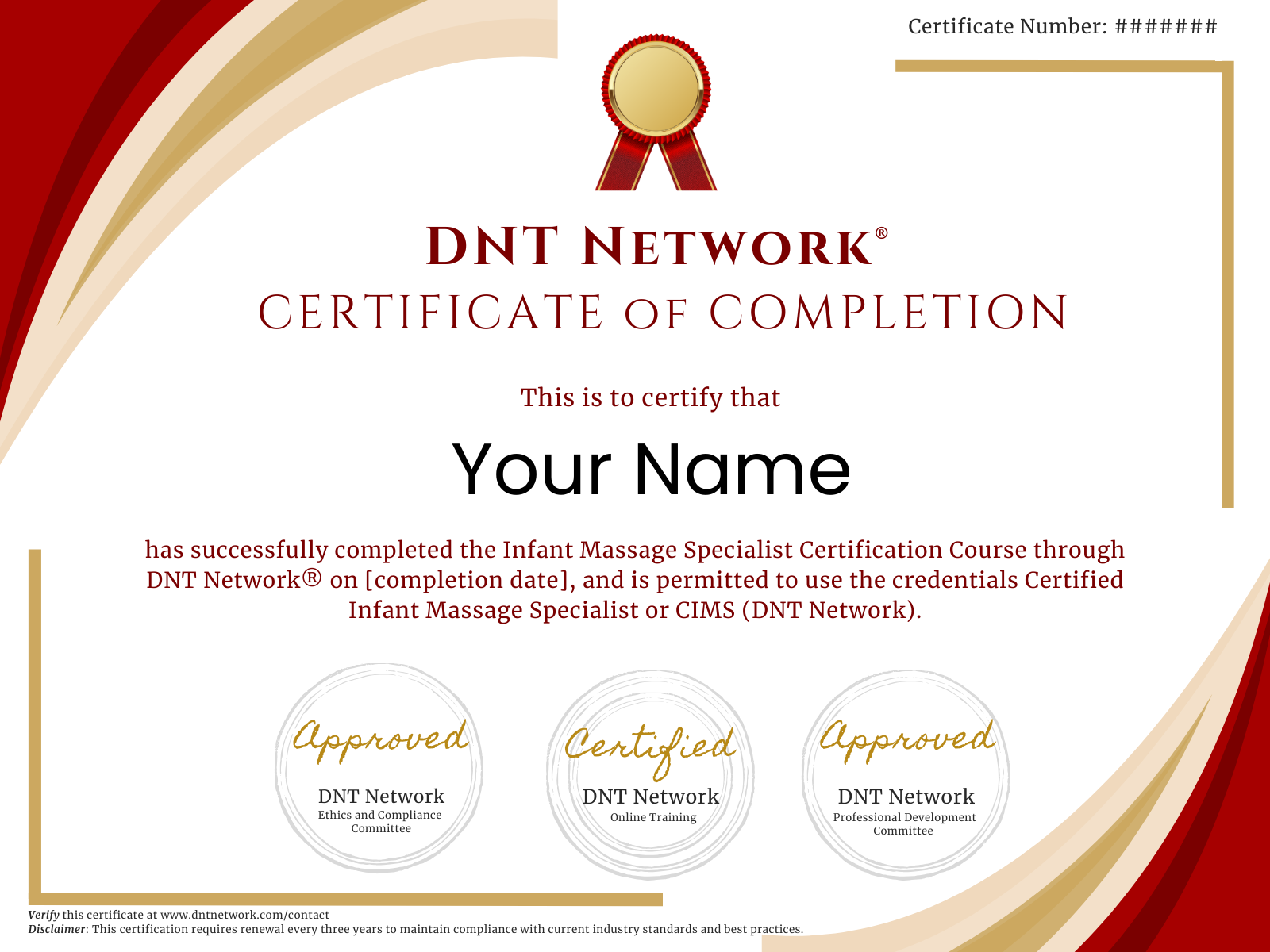
3. Certify (No Hidden Fees)
Pass the final assessment, receive your certification, and start empowering families with confidence.
Comparison of Infant Massage Certification Programs
Trusted & Approved by Medicaid, Carrot, and Insurance Partners




FAQs
-
Yes — the $279 fee is all you’ll ever pay, and it includes everything you need to become a Certified Infant Massage Specialist (CIMS). Your enrollment covers full access to our 90+ hour Infant Massage Specialist Certification Course, lifetime access to all lessons and resources, support when you need it, the final exam and practical evaluations, and your official certification through the DNT Network.
While many infant and perinatal training programs charge $700+—or add renewal fees, exam fees, supervision requirements, or membership add-ons—DNT Network is committed to transparency and accessibility. No hidden costs, no renewals, and no surprise fees.
With DNT Network, you can focus on building real-world skills, supporting families with safe, consent-centered infant massage education, and growing your work—without worrying about extra expenses or expiring access.
-
Most students spend 4–6 hours per week, but the course is fully self-paced, so you can move faster or slower depending on your schedule. There are no fixed deadlines, and you’ll have lifetime access to complete lessons, assessments, and updates at your own pace—designed for busy providers and parents.
-
Yes. You are welcome to enroll even if English is not your primary language. Our team currently supports learners in many widely spoken languages and can provide guidance throughout your certification process.
We commonly support learners in:
Spanish (Español)
Mandarin Chinese (中文 – 普通话)
Hindi (हिन्दी)
Arabic (العربية)
Bengali (বাংলা)
Portuguese (Português)
Russian (Русский)
Japanese (日本語)
Punjabi (ਪੰਜਾਬੀ)
German (Deutsch)
Javanese (Basa Jawa)
Wu Chinese (吴语)
Korean (한국어)
French (Français)
Telugu (తెలుగు)
Marathi (मराठी)
Tamil (தமிழ்)
Turkish (Türkçe)
Vietnamese (Tiếng Việt)
Urdu (اردو)
Italian (Italiano)
Thai (ภาษาไทย)
Gujarati (ગુજરાતી)
Polish (Polski)
Ukrainian (Українська)
Persian / Farsi (فارسی)
Malay (Bahasa Melayu)
Indonesian (Bahasa Indonesia)
Romanian (Română)
Dutch (Nederlands)If you need to complete interviews or written assignments in another language, please contact our support team—we’re happy to work with you.
-
No. This program is 100% online and self-paced. There are no required live calls or scheduled sessions, making it accessible for learners across time zones and with varying schedules. Instructor support is available when you need guidance.
-
No prerequisites or prior infant massage training are required. This certification is open to all education levels and backgrounds. It’s designed for both aspiring and experienced professionals who support babies and families and want practical, consent-centered infant massage education.
Common participants include (but are not limited to):
Doulas, nurses, midwives, childbirth educators, lactation professionals, postpartum providers, newborn care specialists, childcare providers, early childhood professionals, community health workers, social workers, fitness and wellness coaches, medical assistants, and other family-support professionals. -
After completing your certification, you’ll be equipped to support families with safe, consent-centered infant massage education with confidence and clarity. Graduates use this training to strengthen their current work in birth, postpartum, newborn, childcare, or lactation support—or to expand into offering infant massage sessions and parent classes.
You’ll be able to guide caregivers through baby cues (yes/no/maybe), calming routines, safe positioning, and full-body sequences they can actually use at home. You’ll also learn how to adapt for common needs like gas/fussiness, sleep wind-down routines, overstimulation, and sensitive babies—while staying within scope and knowing when to refer to a healthcare provider. This training empowers you to offer practical, family-centered support that builds connection, confidence, and comfort.
-
You’ll have support 7 days a week, so you’re not doing this alone.
Text us anytime: We have a dedicated support number that’s monitored 24/7. If you’re stuck, confused, or just want to double-check something, send a quick message.
Email support too: Great for longer questions, screenshots, or anything that needs detail.
We’ll walk you through it: From course access to video submissions and certification steps, we’ll help you get it done without stress.
-
We believe in:
Evidence-informed, baby-led education grounded in what research suggests about touch, bonding, and regulation—without making promises.
Accessible training without financial or academic barriers.
Consent-centered practice that respects baby cues and caregiver comfort every step of the way.
Culturally responsive care that honors diverse family traditions, routines, and lived experiences.
Practical, real-life application with simple routines and tools families can actually use at home.
Our mission is to equip professionals with safe, ethical, and family-centered infant massage skills that build caregiver confidence and support calm, connected care in everyday life.
-
Students who want extra support can choose DNT Network’s optional mentorship pathway (separate enrollment required). This add-on connects you with experienced Infant Massage Specialists and related infant-care mentors for guided conversations, real-world troubleshooting, and case-based reflection. It’s a practical way to bridge the gap between coursework and real sessions—so you can build confidence, sharpen your teaching skills, and feel more prepared to support families with different babies, routines, and needs.
-
We prioritize accessibility and flexibility. A self-paced format allows students to learn deeply, revisit materials, and integrate knowledge without pressure—while still receiving structured, high-quality education and support.
-
No. This program does not grant licensure, clinical credentials, or therapy qualifications. You’ll be trained as an Infant Massage Specialist/Educator, which means you teach caregivers safe, gentle, baby-led massage routines for bonding and calming—using consent-centered coaching and basic safety guidelines.
An infant massage therapist is typically a licensed healthcare provider (such as an OT, PT, or other regulated clinician) who can assess, diagnose, and treat medical or developmental conditions as part of a clinical plan.
In practice, that means:
Infant Massage Specialist (this certification): education, coaching, parent support, cues/consent, safe routines, referrals when needed.
Licensed therapist: clinical assessment and therapy treatment for conditions (e.g., motor delays, torticollis treatment plans, medically complex cases).
You should always practice within the scope allowed in your state/country and refer families to a pediatric healthcare provider or licensed therapist when concerns go beyond education and general comfort support.
-
Yes. DNT Network offers bundle options that can help you save significantly—often more than 50% compared to enrolling individually.
If you’re interested in combining 2–4 certifications (or more), you can view our current bundle options and pricing here:
https://www.dntnetwork.com/pricing
Bundles are a great option for professionals who want to build complementary skills across birth, postpartum, newborn care, lactation, mental health, fertility, nutrition, and more.
-
We’re happy to help. Please contact our team.
Real Voices, Real Impact.
Hear directly from graduates sharing their experiences with DNT Network’s certification programs
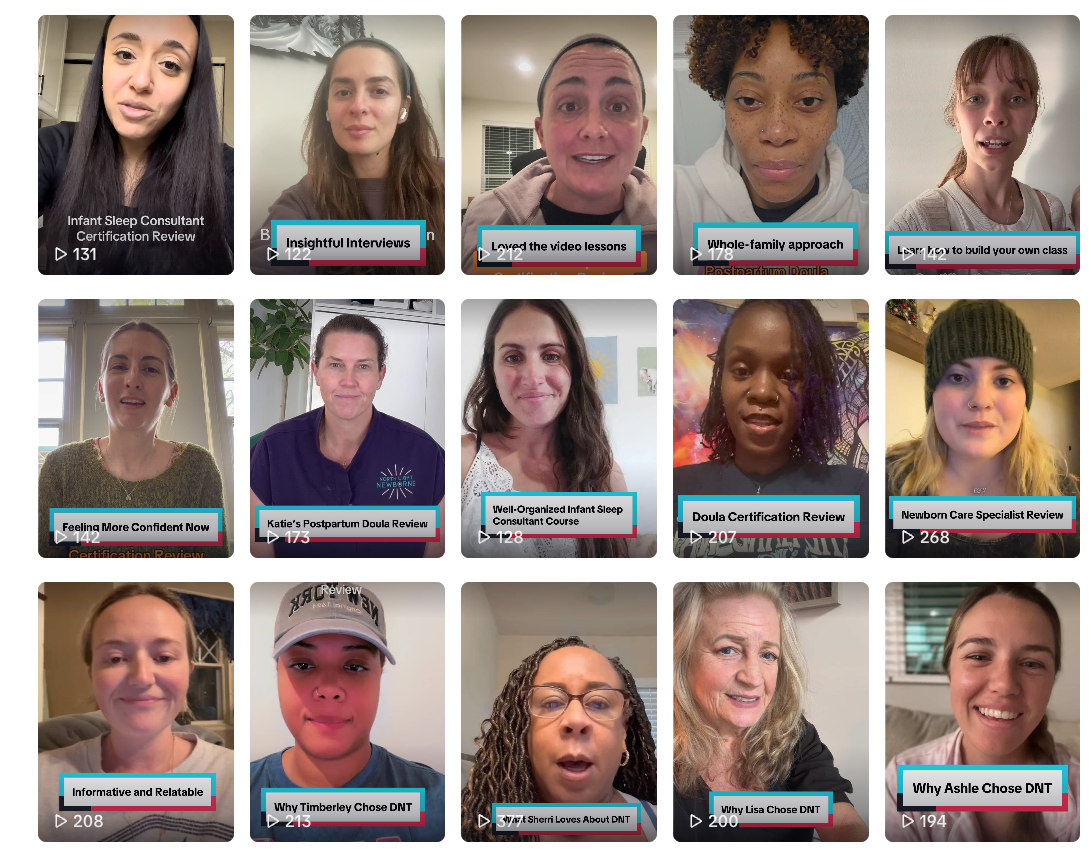
What Our Students Say
“I’ve watched a lot of infant massage videos online, but this was the first program that really taught me how to teach parents—not just how to do the strokes. The cue-led approach changed everything for me. I’m more confident, parents feel less pressure, and sessions feel calmer even when babies fuss or wiggle. The scripts alone are worth it.”
— Jasmine R.
“What sets this course apart is how real it is. It doesn’t pretend babies will lie still and let you ‘finish the routine.’ It teaches you what to do when the baby says no, how to pause without panicking, and how to help parents feel like they’re doing a good job. I started using the simple 2–3 minute routines immediately, and families actually stuck with it.”
— Deja P.
“I’m a postpartum doula and I wanted an infant massage certification that didn’t feel overly clinical or overly ‘woo.’ This hit the sweet spot—clear safety guidance, respectful boundaries, and practical tools I can use in homes with real mess, real noise, and tired parents. I also love that it emphasizes consent with babies. It made me a better coach, not just someone who knows techniques.”
— Kara M.
Join Us Today!