Prenatal & Postpartum Nutritionist Certification Course
Designed for doulas, nurses, midwives, newborn care specialists, childbirth educators, lactation professionals, postpartum providers, fitness and wellness coaches, community health workers, social workers, medical assistants, and other family-support professionals, this $279 Prenatal & Postpartum Nutritionist Certification Course offers 90+ hours of comprehensive, evidence-based perinatal nutrition training—all delivered in a flexible, fully online format for busy professionals.
What you’ll gain:
Evidence-based curriculum — grounded in current research on fertility, pregnancy, postpartum recovery, breastfeeding, and infant nutrition, with monthly research updates to ensure your knowledge stays current as guidelines and evidence evolve—so you can support families with confidence, credibility, and up-to-date information.
Lifetime access — no expirations, renewals, or hidden fees. Once enrolled, you keep access to all course updates forever.
Flexible, self-paced learning — 100% online and designed for real life, with instructor support available when you need it.
Accessible and inclusive — open to all education levels and ages, with no prerequisites required.
Built for real-world application — practical tools, food-first strategies, sample meal guides, and client-ready resources you can use immediately to support families from preconception through the first year postpartum.
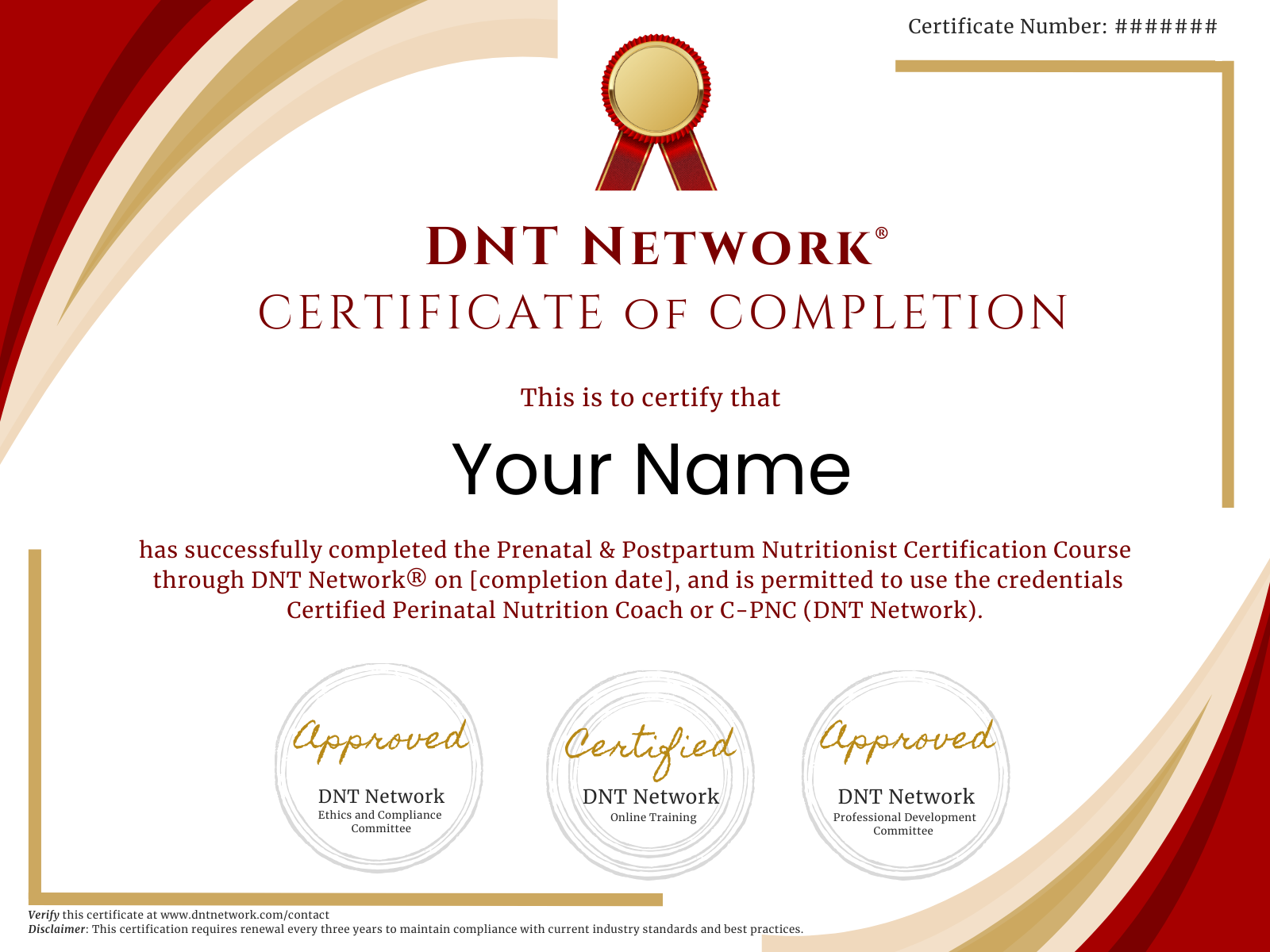
Upon completion, you’ll be recognized as a trusted professional equipped to provide realistic, evidence-based nutritional guidance throughout every stage of the perinatal journey. You’ll also earn the Certified Perinatal Nutrition Coach (C-PNC) credential—demonstrating your expertise to families, employers, and interdisciplinary healthcare teams.
-
-
Lesson 1.0: Course Overview — Welcome to Prenatal & Postpartum Nutrition Training
This course overview introduces DNT Network’s Prenatal & Postpartum Nutritionist Certification Course and gives you a clear picture of what to expect. You’ll learn how the course is structured, what topics you’ll cover, and how this training helps prepare you to support families with evidence-based nutrition guidance from preconception through postpartum.
This course overview introduces DNT Network’s Prenatal & Postpartum Nutritionist Certification Course and gives you a clear picture of what to expect. You’ll learn how the course is structured, what topics you’ll cover, and how this training helps prepare you to support families with evidence-based nutrition guidance from preconception through postpartum.
-
Lesson 1.1: Nutrition Across Preconception, Pregnancy, and Postpartum
This lesson introduces how nutritional needs shift before conception, throughout pregnancy, and into postpartum recovery. You’ll explore why preconception nutrition matters for fertility, hormone balance, and nutrient stores—even when clients don’t identify as “preconception.” We’ll connect early nourishment to pregnancy and postpartum outcomes and show you how to support clients at each stage in a practical, scope-appropriate way without overwhelm.
This lesson introduces how nutritional needs shift before conception, throughout pregnancy, and into postpartum recovery. You’ll explore why preconception nutrition matters for fertility, hormone balance, and nutrient stores—even when clients don’t identify as “preconception.” We’ll connect early nourishment to pregnancy and postpartum outcomes and show you how to support clients at each stage in a practical, scope-appropriate way without overwhelm.
-
Lesson 1.2: Understanding, Evaluating, and Translating Nutrition Research
Clients are often confused by outdated advice, headlines, and social media trends. In this lesson, you’ll learn how to evaluate nutrition research, recognize high-quality evidence, and understand why guidelines sometimes lag behind current findings. More importantly, you’ll practice translating research into clear, realistic guidance clients can actually use. This helps you speak with confidence while staying evidence-informed and ethical.
Clients are often confused by outdated advice, headlines, and social media trends. In this lesson, you’ll learn how to evaluate nutrition research, recognize high-quality evidence, and understand why guidelines sometimes lag behind current findings. More importantly, you’ll practice translating research into clear, realistic guidance clients can actually use. This helps you speak with confidence while staying evidence-informed and ethical.
-
Lesson 1.3: Scope of Practice, Ethics & Referrals
This lesson clarifies what perinatal nutrition coaches can and cannot do within a non-clinical scope of practice. You’ll learn how to provide meaningful, evidence-informed support without diagnosing conditions, prescribing supplements, or replacing medical care. We’ll cover when and how to refer clients to registered dietitians or healthcare providers, and how to communicate boundaries ethically. This clarity protects both you and your clients while strengthening trust and collaboration.
This lesson clarifies what perinatal nutrition coaches can and cannot do within a non-clinical scope of practice. You’ll learn how to provide meaningful, evidence-informed support without diagnosing conditions, prescribing supplements, or replacing medical care. We’ll cover when and how to refer clients to registered dietitians or healthcare providers, and how to communicate boundaries ethically. This clarity protects both you and your clients while strengthening trust and collaboration.
-
-
-
Lesson 2.1: Core Nutrient Needs During Pregnancy
Pregnancy increases the body’s demand for specific nutrients, including protein, iron, folate, iodine, calcium, and healthy fats. This lesson explains why these nutrients matter and how food-first strategies can support them. You’ll learn how to discuss nutrient needs without strict rules or rigid meal plans. The focus is on flexibility, adequacy, and supporting real-life eating patterns.
Pregnancy increases the body’s demand for specific nutrients, including protein, iron, folate, iodine, calcium, and healthy fats. This lesson explains why these nutrients matter and how food-first strategies can support them. You’ll learn how to discuss nutrient needs without strict rules or rigid meal plans. The focus is on flexibility, adequacy, and supporting real-life eating patterns.
-
Lesson 2.2: Food-First Support for Pregnancy Symptoms and Conditions
Nausea, heartburn, constipation, fatigue, and appetite changes are common—and often misunderstood. This lesson also addresses pregnancy-related concerns such as gestational diabetes risk, low iron, and blood sugar regulation from a non-clinical perspective. You’ll learn how food choices can support comfort and nourishment without fear-based messaging. The emphasis is on practical adjustments that meet clients where they are.
Nausea, heartburn, constipation, fatigue, and appetite changes are common—and often misunderstood. This lesson also addresses pregnancy-related concerns such as gestational diabetes risk, low iron, and blood sugar regulation from a non-clinical perspective. You’ll learn how food choices can support comfort and nourishment without fear-based messaging. The emphasis is on practical adjustments that meet clients where they are.
-
Lesson 2.3: Weight, Body Image, and Gentle Nutrition in Pregnancy
Many clients feel pressure around weight gain and body changes during pregnancy. This lesson teaches you how to navigate these conversations with sensitivity, using a non-diet and trauma-informed approach. You’ll learn how to shift the focus toward nourishment, function, and well-being rather than numbers on a scale. This helps clients feel supported instead of judged.
Many clients feel pressure around weight gain and body changes during pregnancy. This lesson teaches you how to navigate these conversations with sensitivity, using a non-diet and trauma-informed approach. You’ll learn how to shift the focus toward nourishment, function, and well-being rather than numbers on a scale. This helps clients feel supported instead of judged.
-
-
-
Lesson 3.1: Nutrition for Postpartum Healing and Depletion
Postpartum recovery places significant demands on the body, especially after blood loss, sleep deprivation, and hormonal shifts. This lesson explores nutrients and foods that support healing, energy, and emotional resilience. You’ll learn how to support clients experiencing exhaustion without expecting perfection. The focus is on rebuilding, replenishing, and sustainable nourishment.
Postpartum recovery places significant demands on the body, especially after blood loss, sleep deprivation, and hormonal shifts. This lesson explores nutrients and foods that support healing, energy, and emotional resilience. You’ll learn how to support clients experiencing exhaustion without expecting perfection. The focus is on rebuilding, replenishing, and sustainable nourishment.
-
Lesson 3.2: Nutrition for Breastfeeding and Chestfeeding Support
Breastfeeding and chestfeeding increase energy and nutrient needs, yet many parents feel unsure about what they “should” be eating. This lesson covers hydration, calorie needs, and food-first approaches to supporting milk production without supplements or rigid rules. You’ll also learn how to address common concerns while staying within your scope. The goal is confidence, not pressure.
Breastfeeding and chestfeeding increase energy and nutrient needs, yet many parents feel unsure about what they “should” be eating. This lesson covers hydration, calorie needs, and food-first approaches to supporting milk production without supplements or rigid rules. You’ll also learn how to address common concerns while staying within your scope. The goal is confidence, not pressure.
-
Lesson 3.3: Infant Nutrition Foundations
This lesson introduces infant nutrition through a perinatal lens, focusing on early feeding environments and parental nourishment. Rather than providing medical feeding advice, it explores how caregiver nutrition and support influence infant well-being. You’ll learn how to answer common questions and know when to refer. This course adds depth without expanding beyond scope.
This lesson introduces infant nutrition through a perinatal lens, focusing on early feeding environments and parental nourishment. Rather than providing medical feeding advice, it explores how caregiver nutrition and support influence infant well-being. You’ll learn how to answer common questions and know when to refer. This course adds depth without expanding beyond scope.
-
-
-
Lesson 4.1: Cultural Food Traditions in the Perinatal Period
Food is deeply tied to culture, identity, and family traditions, especially around pregnancy and postpartum. This lesson explores how to honor cultural practices while supporting nutritional adequacy. You’ll learn how to ask respectful questions and avoid assumptions. Clients feel more supported when their traditions are valued rather than dismissed.
Food is deeply tied to culture, identity, and family traditions, especially around pregnancy and postpartum. This lesson explores how to honor cultural practices while supporting nutritional adequacy. You’ll learn how to ask respectful questions and avoid assumptions. Clients feel more supported when their traditions are valued rather than dismissed.
-
Lesson 4.2: Food Access, Budgeting, and Household Realities
Not all clients have the same access to food, time, or support. This lesson addresses budgeting, grocery access, meal fatigue, and differing household preferences. You’ll learn strategies to support nourishment within real constraints. Practical solutions matter more than ideal plans.
Not all clients have the same access to food, time, or support. This lesson addresses budgeting, grocery access, meal fatigue, and differing household preferences. You’ll learn strategies to support nourishment within real constraints. Practical solutions matter more than ideal plans.
-
Lesson 4.3: Emotional Eating, Food Guilt, and Diet Culture
Pregnancy and postpartum can intensify food guilt and emotional eating. This lesson helps you understand why these patterns arise and how to respond without shame or control. You’ll practice reframing nutrition as care rather than discipline. Clients benefit when they feel safe talking about food honestly.
Pregnancy and postpartum can intensify food guilt and emotional eating. This lesson helps you understand why these patterns arise and how to respond without shame or control. You’ll practice reframing nutrition as care rather than discipline. Clients benefit when they feel safe talking about food honestly.
-
-
-
Lesson 5.1: Conducting a Perinatal Nutrition Intake Session
This lesson walks through how to gather nutrition history while building trust and rapport. You’ll learn what questions to ask, what to avoid, and how to listen for both practical and emotional needs. The intake process sets the tone for effective support. Small shifts in communication can make a big difference.
This lesson walks through how to gather nutrition history while building trust and rapport. You’ll learn what questions to ask, what to avoid, and how to listen for both practical and emotional needs. The intake process sets the tone for effective support. Small shifts in communication can make a big difference.
-
Lesson 5.2: Simple Cooking and Meal Prep for Perinatal Life
Many clients know what they want to eat but struggle with execution. This lesson focuses on simple cooking techniques, batch meals, and low-effort nourishment for pregnancy and postpartum. You’ll learn how to teach realistic strategies rather than idealized routines. Food should feel doable, even on hard days.
Many clients know what they want to eat but struggle with execution. This lesson focuses on simple cooking techniques, batch meals, and low-effort nourishment for pregnancy and postpartum. You’ll learn how to teach realistic strategies rather than idealized routines. Food should feel doable, even on hard days.
-
Lesson 5.3: Behavior Change and Motivational Interviewing
Nutrition change doesn’t happen through information alone. This lesson introduces behavior change principles and motivational interviewing techniques tailored to perinatal clients. You’ll learn how to support progress without pressure or perfectionism. Sustainable change comes from collaboration, not control.
Nutrition change doesn’t happen through information alone. This lesson introduces behavior change principles and motivational interviewing techniques tailored to perinatal clients. You’ll learn how to support progress without pressure or perfectionism. Sustainable change comes from collaboration, not control.
-
-
-
Lesson 6.1: Collaborating Within the Perinatal Care Team
Perinatal nutrition professionals often work alongside doulas, midwives, lactation consultants, and healthcare providers. This lesson covers respectful collaboration, referrals, and communication. You’ll learn how to stay in your lane while still adding value. Strong collaboration improves outcomes for everyone.
Perinatal nutrition professionals often work alongside doulas, midwives, lactation consultants, and healthcare providers. This lesson covers respectful collaboration, referrals, and communication. You’ll learn how to stay in your lane while still adding value. Strong collaboration improves outcomes for everyone.
-
Lesson 6.2: Educating Clients Without Overwhelm
Clients are often already overloaded with information. This lesson focuses on simplifying education into clear, actionable guidance. You’ll learn how to prioritize what matters most for each client. Less information, delivered well, often creates better results.
Clients are often already overloaded with information. This lesson focuses on simplifying education into clear, actionable guidance. You’ll learn how to prioritize what matters most for each client. Less information, delivered well, often creates better results.
-
Lesson 6.3: Designing and Launching Your Perinatal Nutrition Offer
In this final lesson, you’ll apply everything you’ve learned to create a launch-ready offering, such as a workshop, eBook, or nutrition support service. You’ll receive guidance on ethical marketing, pricing, and scope-appropriate language. The final capstone ensures you finish the program confident and ready to serve clients. This is where learning becomes real-world impact.
In this final lesson, you’ll apply everything you’ve learned to create a launch-ready offering, such as a workshop, eBook, or nutrition support service. You’ll receive guidance on ethical marketing, pricing, and scope-appropriate language. The final capstone ensures you finish the program confident and ready to serve clients. This is where learning becomes real-world impact.
-
-
-
Step 1: Final Exam (45 mins)
Complete a 45-minute final exam to assess your understanding of core perinatal nutrition concepts, including fertility nutrition, prenatal nutrient requirements, common pregnancy nutrition concerns, birth-recovery nourishment, breastfeeding nutrition, and culturally sensitive, food-first support strategies. This exam ensures you’re fully prepared to apply evidence-based nutrition guidance when supporting parents through preconception, pregnancy, and postpartum.
Complete a 45-minute final exam to assess your understanding of core perinatal nutrition concepts, including fertility nutrition, prenatal nutrient requirements, common pregnancy nutrition concerns, birth-recovery nourishment, breastfeeding nutrition, and culturally sensitive, food-first support strategies. This exam ensures you’re fully prepared to apply evidence-based nutrition guidance when supporting parents through preconception, pregnancy, and postpartum.
-
Step 2: Practical Skills Evaluation
Assess your ability to apply perinatal nutrition principles in real-world scenarios. This evaluation focuses on effective client communication, identifying common nutrition concerns during fertility, pregnancy, and postpartum, creating realistic and culturally sensitive nutrition plans, demonstrating a food-first approach, and providing supportive, evidence-based guidance with empathy and professionalism.
Assess your ability to apply perinatal nutrition principles in real-world scenarios. This evaluation focuses on effective client communication, identifying common nutrition concerns during fertility, pregnancy, and postpartum, creating realistic and culturally sensitive nutrition plans, demonstrating a food-first approach, and providing supportive, evidence-based guidance with empathy and professionalism.
-
Step 3.1: Interview Assignment (1 hr)
As part of the Prenatal and Postpartum Nutritionist Certification, you’ll complete two brief interviews: one with a perinatal professional who provides nutrition support and one with a parent who has experienced nutrition challenges during pregnancy or postpartum. These conversations offer real-world insight into family needs and provider practices, strengthening your communication skills, empathy, and ability to deliver practical, client-centered nutrition guidance.
As part of the Prenatal and Postpartum Nutritionist Certification, you’ll complete two brief interviews: one with a perinatal professional who provides nutrition support and one with a parent who has experienced nutrition challenges during pregnancy or postpartum. These conversations offer real-world insight into family needs and provider practices, strengthening your communication skills, empathy, and ability to deliver practical, client-centered nutrition guidance.
-
Step 3.2: Optional Guided Interview Pathway (1 hr)
No professional contacts? No problem. The Optional Guided Interview Pathway connects you with certified perinatal mental health counselors and experienced mentors through warm introductions arranged by the DNT Network team. You’ll gain firsthand insights, ask meaningful questions, and practice professional communication in a supportive, real-world setting. These guided interviews count toward your certification and help build both your confidence and professional network.
No professional contacts? No problem. The Optional Guided Interview Pathway connects you with certified perinatal mental health counselors and experienced mentors through warm introductions arranged by the DNT Network team. You’ll gain firsthand insights, ask meaningful questions, and practice professional communication in a supportive, real-world setting. These guided interviews count toward your certification and help build both your confidence and professional network.
-
Step 3.3: Interview Critique Form
For the Perinatal Nutrition Certification, you’ll submit one Interview Critique Form completed by the professional you interviewed. This form provides constructive feedback on your communication, professionalism, and ability to discuss nutrition topics with clarity, empathy, and cultural sensitivity. It also highlights strengths and areas for growth as you develop confidence in delivering client-centered, evidence-based perinatal nutrition support.
For the Perinatal Nutrition Certification, you’ll submit one Interview Critique Form completed by the professional you interviewed. This form provides constructive feedback on your communication, professionalism, and ability to discuss nutrition topics with clarity, empathy, and cultural sensitivity. It also highlights strengths and areas for growth as you develop confidence in delivering client-centered, evidence-based perinatal nutrition support.
-
Step 4: Recommendation Letters
For the Prenatal and Postpartum Nutritionist Certification, you’ll submit two recommendation letters from individuals who can speak to your professionalism, communication skills, empathy, and readiness to support families with nutrition guidance. Recommenders may include employers, mentors, colleagues, clients, or people familiar with your work. These letters demonstrate your readiness to provide ethical, client-centered prenatal and postpartum nutrition support as a Perinatal Nutrition Coach.
For the Prenatal and Postpartum Nutritionist Certification, you’ll submit two recommendation letters from individuals who can speak to your professionalism, communication skills, empathy, and readiness to support families with nutrition guidance. Recommenders may include employers, mentors, colleagues, clients, or people familiar with your work. These letters demonstrate your readiness to provide ethical, client-centered prenatal and postpartum nutrition support as a Perinatal Nutrition Coach.
-
Step 5: Certification Award (3-5 Business Days)
After completing all course requirements, your materials will be reviewed by the DNT Network team. Within 3–5 business days, you’ll receive your official Certified Perinatal Nutrition Coach (C-PNC) digital certificate along with a unique certification ID, confirming your credential through the DNT Network.
After completing all course requirements, your materials will be reviewed by the DNT Network team. Within 3–5 business days, you’ll receive your official Certified Perinatal Nutrition Coach (C-PNC) digital certificate along with a unique certification ID, confirming your credential through the DNT Network.
-
Three Easy Steps
-

1. Enroll
Sign up for the course and instantly access all training materials and certification requirement from any device.
-

2. Learn
Complete self-paced modules with interactive lessons, videos, and quizzes designed to deepen your knowledge.
-
3. Certify (No Hidden Fees)
Pass the final assessment, receive your certification, and start empowering families with confidence.
Comparison of Prenatal & Postpartum Nutrition Certification Programs
Trusted & Approved by Medicaid, Carrot, and Insurance Partners



FAQs
-
Yes — the $279 fee is all you’ll ever pay, and it includes everything you need to become a Certified Perinatal Nutrition Coach. Your enrollment covers full access to our 90+ hour Perinatal Nutrition Certification Course, lifetime access to all modules and resources, dedicated teacher support, the final exam, and your official certification through the DNT Network.
While many nutrition and perinatal training programs charge $1,500+—or require additional renewal fees, exam fees, supervision fees, or membership add-ons—DNT Network is committed to transparency and accessibility. There are no hidden costs, no renewals, and no surprise fees of any kind.
With DNT Network, you can focus fully on building your skills, supporting families, and growing your career in perinatal nutrition—without worrying about extra expenses or expiring access.
-
Most students spend 4–6 hours per week, but the course is fully self-paced, so you can move faster or slower depending on your schedule. There are no fixed deadlines, and you’ll have lifetime access to complete lessons, assessments, and updates at your own pace—designed for busy providers and parents.
-
No. This program is 100% online and self-paced. There are no required live calls or scheduled sessions, making it accessible for learners across time zones and with varying schedules. Instructor support is available when you need guidance.
-
No prerequisites or prior nutrition training are required. This certification is open to all education levels and backgrounds. It’s designed for both aspiring and experienced professionals who support families during pregnancy and postpartum and want evidence-based, food-first nutrition training.
Common participants include (but are not limited to):
Doulas, nurses, midwives, childbirth educators, lactation professionals, postpartum providers, newborn care specialists, community health workers, social workers, fitness and wellness coaches, medical assistants, and other family-support professionals. -
After completing your certification, you’ll be equipped to provide evidence-based perinatal nutrition support with confidence and clarity. Graduates use this certification to enhance their current work in birth and postpartum care or to expand into prenatal and postpartum nutrition education, coaching, and family support. You’ll be able to guide clients through fertility nutrition, pregnancy nourishment, birth-recovery nutrition, breastfeeding needs, and postpartum wellness with a practical, food-first approach. This training empowers you to offer holistic, informed, and family-centered nutrition care in both personal and professional settings.
-
You’ll receive dedicated support 7 days a week.
-
We believe in:
Evidence-based, food-first education grounded in current research
Accessible training without financial or academic barriers
Culturally responsive care that honors diverse food traditions and lived experiences
Practical, real-life application over rigid or idealized nutrition rules
Our mission is to equip professionals with realistic, ethical nutrition knowledge that truly supports families during preconception, pregnancy, and postpartum.
-
Students who want additional guidance can participate in DNT Network’s optional mentorship pathway, which connects new professionals with experienced Perinatal Nutrition Coaches, birth and postpartum educators, lactation specialists, and other seasoned perinatal mentors. Through guided discussions, observation, and case-based reflection, mentees gain practical insight into real-world applications of perinatal nutrition support. This optional experience helps bridge the gap between theory and practice—building confidence, strengthening professional skills, and preparing you to support families with diverse nutritional needs.
-
We prioritize accessibility and flexibility. A self-paced format allows students to learn deeply, revisit materials, and integrate knowledge without pressure—while still receiving structured, high-quality education and support.
-
No. This program does not grant licensure or clinical credentials. Graduates must practice within the scope allowed by their state or country. The course provides education and coaching-based nutrition support, not medical or clinical nutrition therapy.
-
We’re happy to help. Please contact our team.
-
Yes. You are welcome to enroll even if English is not your primary language. Our team currently supports learners in many widely spoken languages and can provide guidance throughout your certification process.
We commonly support learners in:
Spanish (Español)
Mandarin Chinese (中文 – 普通话)
Hindi (हिन्दी)
Arabic (العربية)
Bengali (বাংলা)
Portuguese (Português)
Russian (Русский)
Japanese (日本語)
Punjabi (ਪੰਜਾਬੀ)
German (Deutsch)
Javanese (Basa Jawa)
Wu Chinese (吴语)
Korean (한국어)
French (Français)
Telugu (తెలుగు)
Marathi (मराठी)
Tamil (தமிழ்)
Turkish (Türkçe)
Vietnamese (Tiếng Việt)
Urdu (اردو)
Italian (Italiano)
Thai (ภาษาไทย)
Gujarati (ગુજરાતી)
Polish (Polski)
Ukrainian (Українська)
Persian / Farsi (فارسی)
Malay (Bahasa Melayu)
Indonesian (Bahasa Indonesia)
Romanian (Română)
Dutch (Nederlands)If you need to complete interviews or written assignments in another language, please contact our support team—we’re happy to work with you.
-
Yes. DNT Network offers bundle options that can help you save significantly—often more than 50% compared to enrolling individually.
If you’re interested in combining 2–4 certifications (or more), you can view our current bundle options and pricing here:
https://www.dntnetwork.com/pricing
Bundles are a great option for professionals who want to build complementary skills across birth, postpartum, newborn care, lactation, mental health, fertility, nutrition, and more.
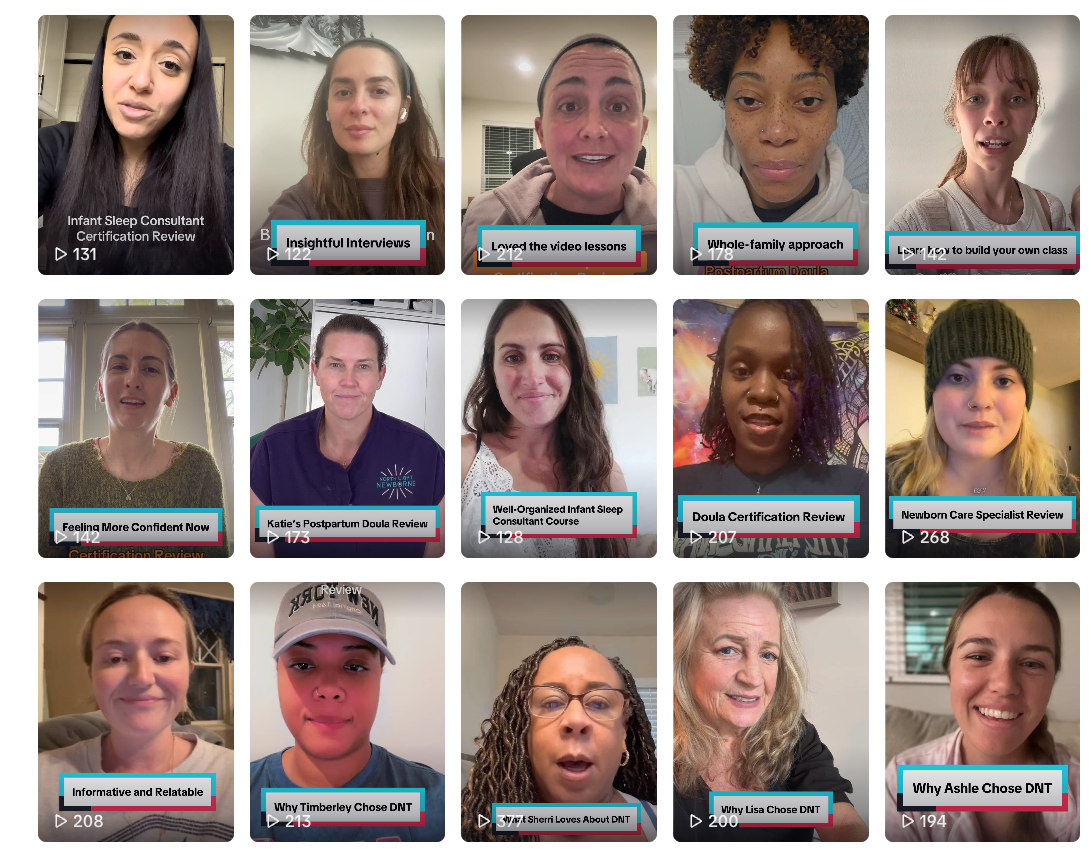
Real Voices, Real Impact.
Hear directly from graduates sharing their experiences with DNT Network’s certification programs
What Our Students Say
“Before taking this course, I felt unsure how to talk about nutrition with my prenatal and postpartum clients without sounding overwhelming or outdated. This certification completely changed that. The training helped me understand why nutrition matters at each stage and how to explain it in a way families actually understand and use. I now feel confident supporting clients with real, food-first guidance and knowing when to refer out. I’m honestly amazed by how comprehensive and practical the course is for such an affordable price.”
— Lauren L.
“What I loved most about this program is how real and usable it is. Every module connects directly to situations I see with clients—low energy, poor appetite, confusion about supplements, and feeling guilty about food choices. This isn’t just theory; it’s guidance I can apply immediately in my work. The food-first approach and emphasis on flexibility helped me support families without adding stress or unrealistic expectations. This course has become a core part of how I show up for my clients.”
— Michelle K.
“As a birth doula, I knew nutrition mattered, but I didn’t feel confident enough to talk about it beyond general advice. The 90+ hours of training gave me a solid foundation in prenatal and postpartum nutrition and, more importantly, taught me how to communicate that information with empathy and professionalism. I loved that the course is self-paced and realistic for busy professionals. I started using what I learned right away, and my clients noticed the difference.”
— Morgan S.

Join Us Today!