Bereavement Doula Certification Course
Designed for doulas, nurses, midwives, newborn care specialists, childbirth educators, lactation professionals, postpartum providers, social workers, community health workers, medical assistants, hospice and end-of-life doulas, and other family-support professionals, this $199 Bereavement Doula Certification Course provides comprehensive, compassionate training in perinatal loss, pregnancy loss, stillbirth, neonatal loss, infant loss, and grief support—all delivered in a flexible, fully online format for busy professionals.
What you’ll gain:
Trauma-informed bereavement support training — learn how to support families through miscarriage, stillbirth, neonatal loss, termination for medical reasons, life-limiting diagnoses, and infant loss with compassion, sensitivity, and professionalism.
Compassionate communication skills — gain practical language, listening tools, and emotional support strategies for walking alongside grieving parents and families without minimizing, fixing, or rushing their grief.
Flexible, self-paced learning — 100% online and designed for real life, with instructor support available when you need it.
Accessible and inclusive — open to all education levels and ages, with no prerequisites required.
Built for real-world application — practical tools, memory-making guidance, family support strategies, referral resources, and client-ready approaches you can use immediately in hospitals, birth settings, homes, and community care.
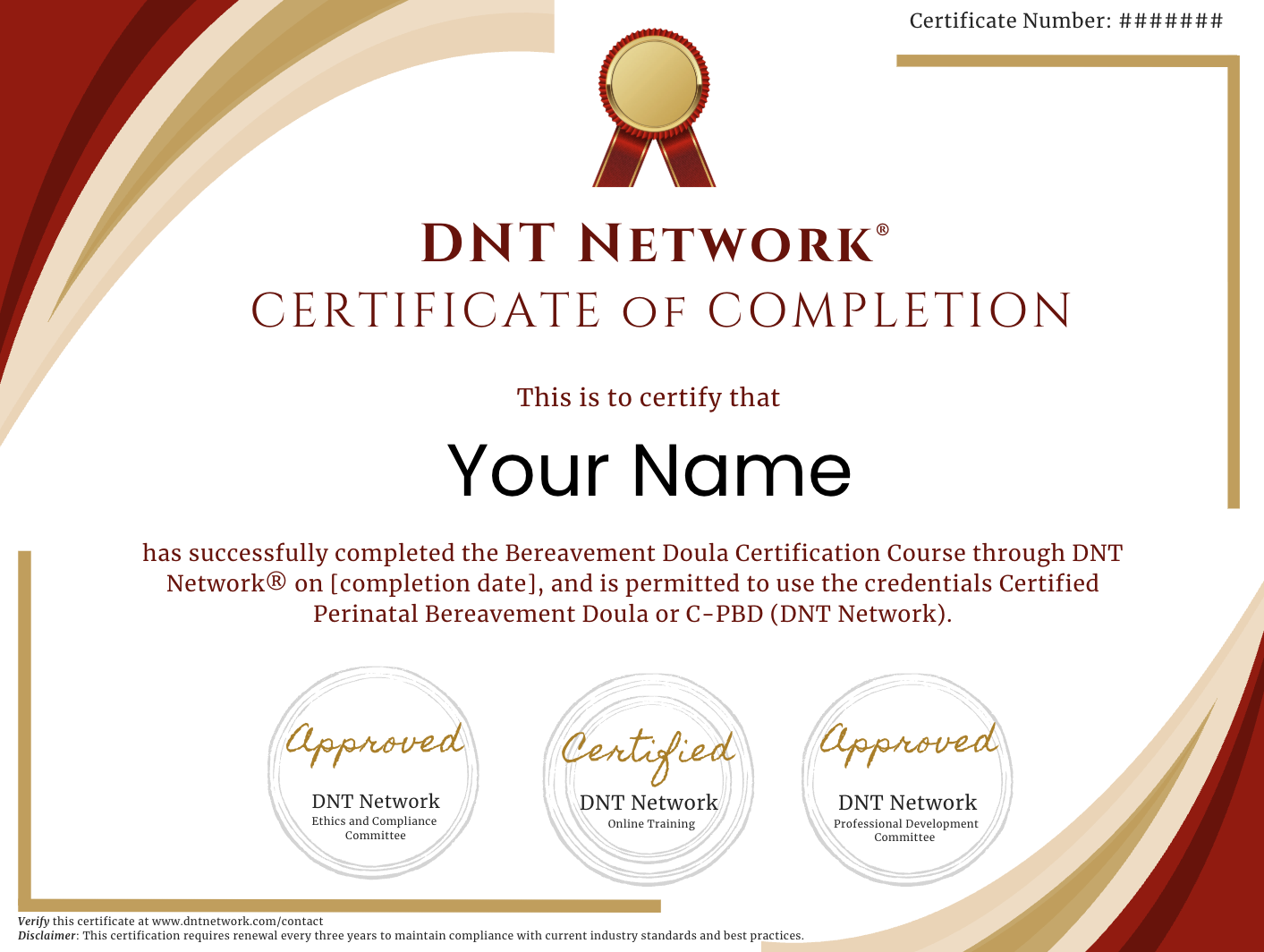
Upon completion, you’ll earn the Certified Perinatal Bereavement Doula (C-PBD) credential, demonstrating your specialized training in supporting families through miscarriage, stillbirth, neonatal loss, infant loss, and grief.
-
Module 1: Foundations of Perinatal Loss & Bereavement Doula Work — 6 Hours
-
Lesson 1.0: Course Overview — Welcome to Bereavement Doula Training
This course overview introduces DNT Network’s Bereavement Doula Certification Course and gives you a clear picture of what to expect. You’ll learn how the course is structured, what topics you’ll cover, and how this training prepares you to provide compassionate, trauma-informed support to families experiencing perinatal loss, pregnancy loss, stillbirth, neonatal loss, infant loss, and grief.
-
Lesson 1.1: Understanding Perinatal Loss: Definitions & Landscape
Establishing shared language for the losses families experience and the cultural silence that has often surrounded them.
-
Lesson 1.2: The Role of the Bereavement Doula
What this work actually looks like in practice, and the boundaries that protect both families and practitioners.
-
Lesson 1.3: Ethics, Boundaries & Cultural Humility
Building the ethical foundation for showing up consistently, safely, and without imposing your own framework.
-
Module 1 Assessment
-
-
Module 2: Grief, Trauma & the Bereaved Family — 7 Hours
-
Lesson 2.1: Models of Grief: Beyond the Five Stages
Moving past Kubler-Ross to models that better describe how grief actually unfolds.
-
Lesson 2.2: Trauma-Informed Care in Perinatal Loss
Many perinatal losses are experienced as traumatic; supporting families means understanding why.
-
Lesson 2.3: Family Systems: Partners, Siblings & Extended Family
Loss happens to a family, not just to a birthing parent. Each member grieves differently.
-
Module 2 Assessment
-
-
Module 3: Clinical & Medical Context of Perinatal Loss — 7 Hours
-
Lesson 3.1: Types of Loss & Their Medical Pathways
A grounded overview of the medical realities families encounter, by type of loss.
-
Lesson 3.2: Hospital Navigation & Birth Plans for Loss
How to help families exercise agency in a setting that can feel disempowering.
-
Lesson 3.3: Postpartum Recovery After Loss
The body continues a postpartum process even when the baby has died, and families need preparation.
-
Module 3 Assessment
-
-
Module 4: Companioning Skills & Compassionate Communication — 7 Hours
-
Lesson 4.1: The Art of Presence & Active Listening
Learning to sit with grief without rushing to soften it.
-
Lesson 4.2: Language That Heals, Language That Harms
Even well-meant words can cause damage. This lesson focuses on what to say and what to avoid.
-
Lesson 4.3: Communication Across Channels
Modern bereavement support happens in person, on the phone, in messages, and in writing.
-
Module 4 Assessment
-
-
Module 5: Ritual, Memory-Making & Continuing Bonds — 6 Hours
-
Lesson 5.1: Memory-Making in the Hospital & at Home
Practical, hands-on practices for creating keepsakes and meaningful moments.
-
Lesson 5.2: Ritual, Spirituality & Cultural Practice
Honoring the family's framework, whether religious, secular, or somewhere in between.
-
Lesson 5.3: Long-Term Continuing Bonds & Milestones
Support does not end at discharge. Grief reshapes itself across years.
-
Module 5 Assessment
-
-
Module 6: Self-Care, Professional Practice & Certification — 7 Hours
-
Lesson 6.1: Sustaining Yourself: Vicarious Trauma & Self-Care
You cannot pour from an empty vessel, and bereavement work has unique occupational risks.
-
Lesson 6.2: Building Your Practice
Turning training into a viable, ethical practice that can serve families consistently.
-
Lesson 6.3: Course Capstone
The structured pathway to becoming a DNT Network Certified Perinatal Loss & Bereavement Support Doula.
-
Module 6 Assessment
-
-
Final Assessment
-
Step 1: Final Exam (45 mins)
Complete a 45-minute final exam to assess your understanding of core bereavement doula concepts, including perinatal loss, pregnancy loss, stillbirth, neonatal loss, infant loss, trauma-informed care, compassionate communication, memory-making, ethical boundaries, cultural humility, referral practices, and postpartum recovery after loss. This exam helps ensure you’re prepared to provide safe, compassionate, and professional support to grieving families.
-
Step 2: Practical Skills Evaluation
Assesses your ability to apply bereavement doula principles in real-world scenarios. This evaluation focuses on compassionate communication, trauma-informed support, ethical boundaries, cultural humility, recognizing family needs after perinatal loss, offering memory-making options, identifying appropriate referrals, and providing steady, professional support to grieving families with empathy and care.
-
Step 3.1: Interview Assignment — Bereavement Support Perspective
Complete one interview with either a professional experienced in perinatal loss support or someone who has personally experienced perinatal loss. This assignment helps you better understand grief, family needs, communication, and compassionate bereavement care in real-world situations.
-
Step 3.2: Optional Guided Interview Pathway (1 hr)
If you do not have a professional contact, you may use DNT Network’s Optional Guided Interview Pathway. This option connects you with an approved mentor or experienced bereavement support professional so you can complete your interview assignment, ask meaningful questions, and gain real-world insight into perinatal loss support.
-
Step 4: Recommendation Letters
Submit two recommendation letters from people who can speak to your professionalism, empathy, communication skills, emotional maturity, and readiness to support grieving families. Recommenders may include employers, mentors, colleagues, supervisors, instructors, clients, friends, or others familiar with your work.
-
Step 5: Certification Award (3-5 Business Days)
After completing all course requirements, your materials will be reviewed by the DNT Network team. Within 3–5 business days, you’ll receive your official Certified Perinatal Bereavement Doula (C-PBD) digital certificate along with a unique certification ID, confirming your credential through DNT Network.
-
Why Students Choose DNT Network
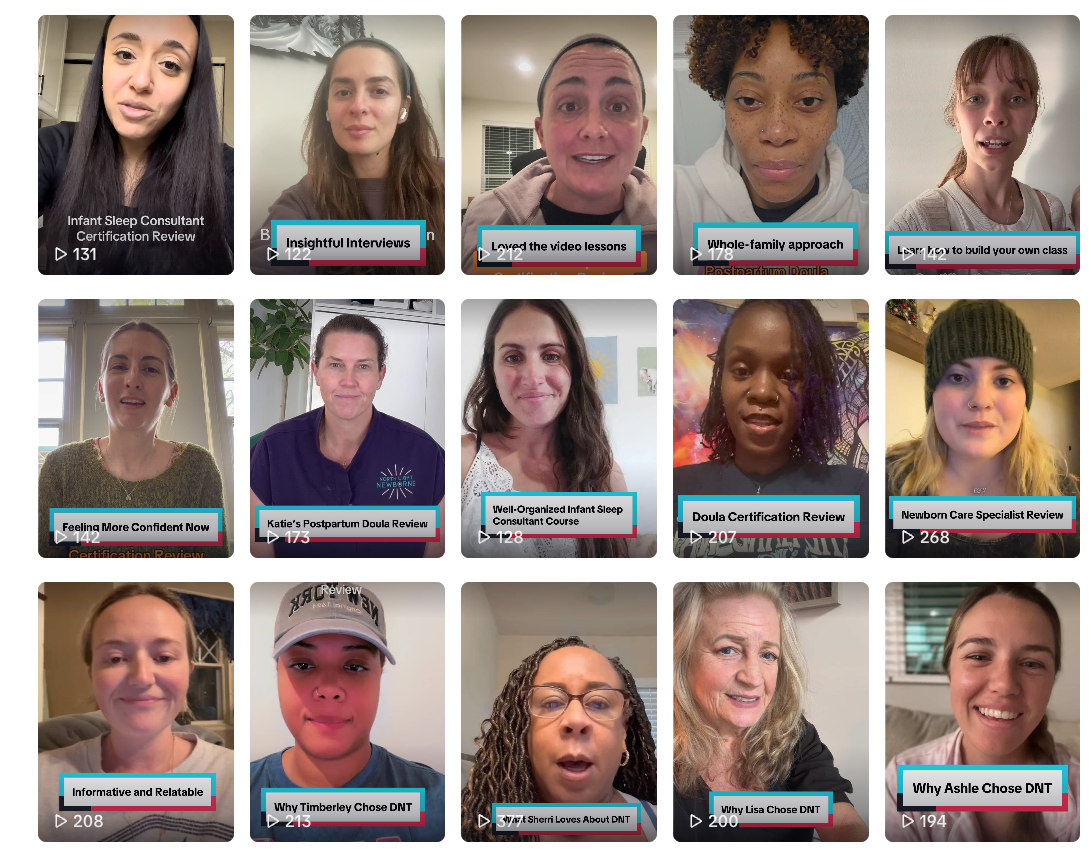
Hear from learners who chose DNT Network for compassionate, practical, and accessible Bereavement Doula training—and how the course helped them feel more prepared to support individuals and families through loss with empathy and confidence.
Three Easy Steps
-

1. Enroll
Sign up for the course and instantly access all training materials and certification requirement from any device.
-

2. Learn
Complete self-paced modules with interactive lessons, videos, and quizzes designed to deepen your knowledge.
-
3. Certify (No Hidden Fees)
Pass the final assessment, receive your certification, and start empowering families with confidence.
FAQs
-
Yes — the $199 fee is all you'll ever pay, and it includes everything you need to become a Certified Perinatal Loss & Bereavement Support Doula. Your enrollment covers full access to the complete 40-hour Perinatal Loss & Bereavement Support Doula Certification Course, lifetime access to all modules and resources, dedicated teacher support, the final exam and practical skills assessments, and your official certification through the DNT Network.
While many doula and bereavement training programs charge $1,500+—or require additional renewal fees, exam fees, supervision fees, or membership add-ons—DNT Network is committed to transparency and accessibility. There are no hidden costs and no surprise fees of any kind. Even certification renewal is free: your credential is renewed every three years through continuing education that's included at no charge, right inside your learning portal.
With DNT Network, you can focus fully on building your skills, supporting grieving families, and growing your career in bereavement support—without worrying about extra expenses or expiring access.
-
Most students spend 4–6 hours per week and complete the 40-hour course in about 1–2 months, but the program is fully self-paced, so you can move faster or slower depending on your schedule. There are no fixed deadlines, and you'll have lifetime access to complete lessons, assessments, and updates at your own pace—designed for busy birth workers, healthcare providers, and parents.
-
No. The core program is 100% online and self-paced. There are no required live calls or scheduled sessions, making it accessible for learners across time zones and with varying schedules. Instructor support is available when you need guidance.
The one exception is our optional mentorship program: if you choose to add mentorship, it does include live calls with your mentor, scheduled at times that work for you. The certification itself never requires live attendance.
-
No prerequisites or prior bereavement support training are required. This certification is open to all education levels and backgrounds. It’s designed for both aspiring and experienced professionals who support families during pregnancy, birth, postpartum, infancy, grief, or family crisis and want compassionate, trauma-informed training in perinatal loss and bereavement care.
Common participants include, but are not limited to:
Doulas, nurses, midwives, childbirth educators, lactation professionals, postpartum providers, newborn care specialists, social workers, community health workers, hospice and end-of-life doulas, chaplains, grief support workers, mental health professionals, medical assistants, funeral professionals, and other family-support professionals. -
After completing your certification, you’ll be equipped to provide compassionate, trauma-informed bereavement support to families experiencing perinatal loss, pregnancy loss, stillbirth, neonatal loss, infant loss, and grief. Graduates may use this certification to strengthen their current work in birth, postpartum care, healthcare, grief support, family support, or community care, or to expand into specialized perinatal bereavement services.
You’ll be able to support families with emotional presence, compassionate communication, memory-making options, hospital and home support, postpartum recovery after loss, referral awareness, and long-term grief sensitivity. This training prepares you to offer ethical, family-centered support while staying within a clear non-clinical scope of practice.
-
Bereavement doulas are typically hired by individuals and families who are experiencing pregnancy loss, stillbirth, infant loss, or the death of a loved one. They may also work with or receive referrals from hospitals, birth centers, hospice organizations, funeral homes, grief-support programs, nonprofit organizations, faith-based organizations, and community health agencies.
-
You’ll receive dedicated learner support 7 days a week throughout your certification journey. If you have questions about course access, assignments, final assessment requirements, interview steps, or certification submission, our support team is available to help you stay on track.
Because bereavement work can feel emotionally sensitive, you are not expected to figure everything out alone. Our team can help clarify expectations, guide you through the certification steps, and answer questions as you move through topics such as perinatal loss, trauma-informed care, memory-making, communication, scope of practice, and ethical support.
The course is self-paced, but you’ll still have support when you need it, so you can move through the training with more confidence and clarity.
-
We believe in:
Evidence-based, family-centered education grounded in contemporary grief research
Accessible training without financial or academic barriers
Culturally responsive care that honors diverse grief traditions, faiths, and lived experiences
Compassionate, real-world practice over rigid scripts or one-size-fits-all approaches to grief
Our mission is to equip professionals with skilled, ethical bereavement support knowledge that truly serves families before, during, and after perinatal loss.
-
Yes. Students who want extra guidance may choose DNT Network’s optional guided mentorship pathway. This pathway is especially helpful if you do not yet have professional contacts in perinatal loss or feel unsure about completing the interview requirement on your own.
Through this option, DNT Network can help connect you with an approved mentor or experienced professional who has supported families through pregnancy loss, stillbirth, neonatal loss, infant loss, or grief. You’ll have the opportunity to ask questions, learn from real-world bereavement support experience, and better understand what compassionate, ethical care looks like in practice.
This mentorship pathway is optional, but it can be a valuable way to build confidence, strengthen your communication skills, and feel more prepared to support grieving families with care and professionalism.
-
We prioritize accessibility and flexibility. A self-paced format allows students to learn deeply, revisit materials, and integrate knowledge without pressure—while still receiving structured, high-quality education and support.
-
Yes. You are welcome to enroll even if English is not your primary language. Our team currently supports learners in many widely spoken languages and can provide guidance throughout your certification process.
We commonly support learners in:
Spanish (Español)
Mandarin Chinese (中文 – 普通话)
Hindi (हिन्दी)
Arabic (العربية)
Bengali (বাংলা)
Portuguese (Português)
Russian (Русский)
Japanese (日本語)
Punjabi (ਪੰਜਾਬੀ)
German (Deutsch)
Javanese (Basa Jawa)
Wu Chinese (吴语)
Korean (한국어)
French (Français)
Telugu (తెలుగు)
Marathi (मराठी)
Tamil (தமிழ்)
Turkish (Türkçe)
Vietnamese (Tiếng Việt)
Urdu (اردو)
Italian (Italiano)
Thai (ภาษาไทย)
Gujarati (ગુજરાતી)
Polish (Polski)
Ukrainian (Українська)
Persian / Farsi (فارسی)
Malay (Bahasa Melayu)
Indonesian (Bahasa Indonesia)
Romanian (Română)
Dutch (Nederlands)If you need to complete interviews or written assignments in another language, please contact our support team—we’re happy to work with you.
-
Yes. DNT Network offers bundle options that can help you save significantly—often more than 50% compared to enrolling individually.
If you’re interested in combining 2–4 certifications (or more), you can view our current bundle options and pricing here:
https://www.dntnetwork.com/pricing
Bundles are a great option for professionals who want to build complementary skills across birth, postpartum, newborn care, lactation, mental health, fertility, nutrition, and more.
-
We’re happy to help. Please contact our team.
Trusted & Approved by Medicaid, Carrot, and Insurance Partners





Real Voices, Real Impact.
Hear directly from graduates sharing their experiences with DNT Network’s certification programs
What Our Students Say
“I put off bereavement training for years because I was scared of it, honestly. I'd been a doula for a while but every time a client had a loss I felt like I was tiptoeing, terrified of saying the wrong thing. This course got me past that. It didn't hand me magic words — it taught me why certain things help and certain things hurt, and how to just be in the room. I also know now when something's beyond my role and who to send families to. For what it costs, I still don't quite understand how they fit this much in.”
— Alyssa R.
“What got me is how usable it all is. Nothing in this course felt theoretical. The stuff about family members saying the wrong thing, parents frozen over decisions about photos, the awkward silence when you don't know if you should mention the baby — that's my actual week. I've pulled the scripts up on my phone in a hospital parking lot before walking in. Not exaggerating. It's become the backbone of how I show up for grieving families.”
— Danielle M.
“As a birth and postpartum professional, I had supported families through difficult experiences before, but I did not feel fully prepared for perinatal loss work. This certification helped me build a stronger foundation in grief, trauma, postpartum recovery after loss, memory-making, and long-term support. I now feel more confident speaking with families, collaborating with care teams, and offering calm, ethical support during incredibly vulnerable moments. The course was clear, meaningful, and deeply needed.”
— Brianna C.


Join Us Today!